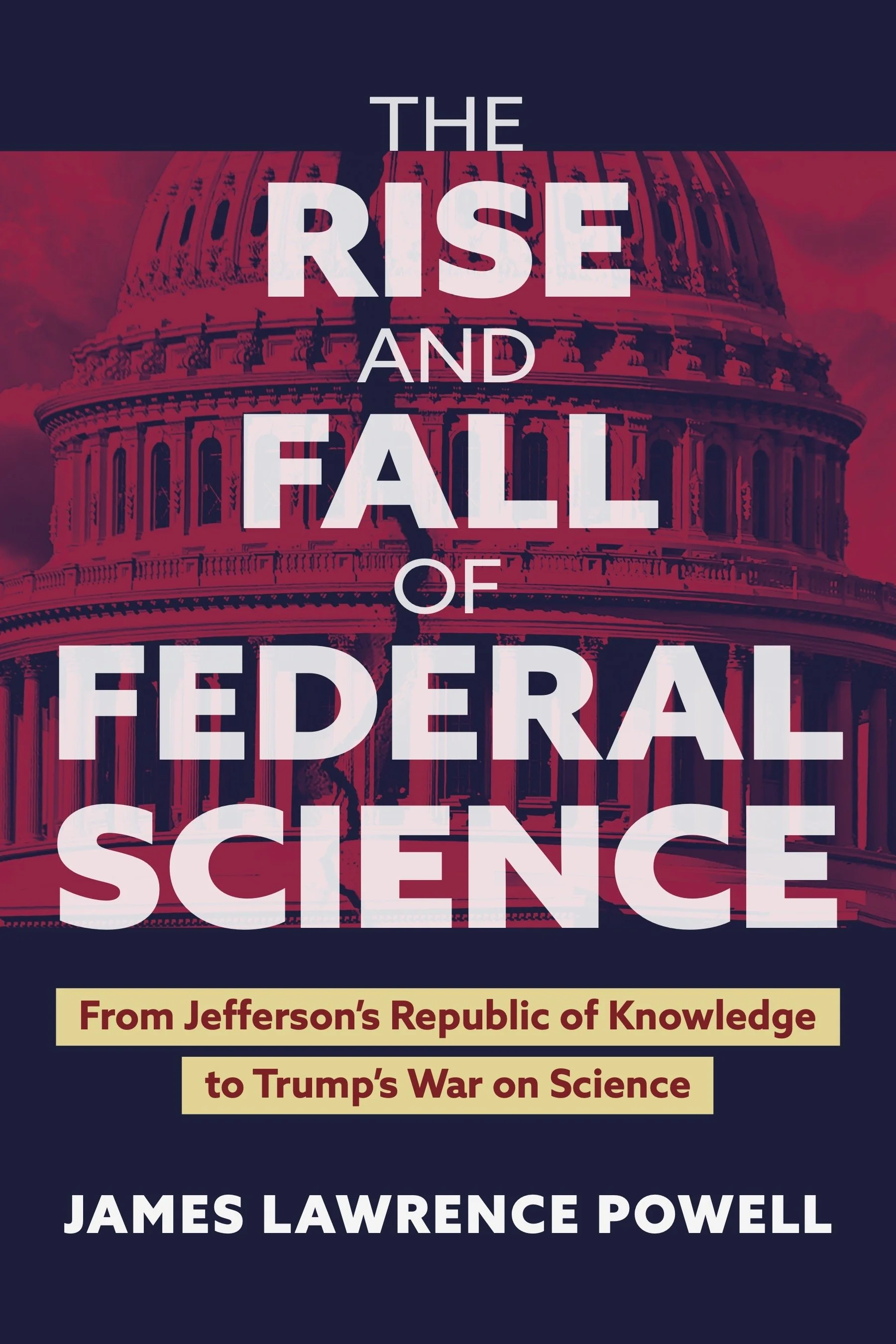
The Rise and Fall of Federal Science
Over more than two centuries, the United States built an extraordinary partnership between government and science. Beginning with the first federal scientific expeditions and surveys, expanding through the agencies of the nineteenth and early twentieth centuries, and culminating in the postwar system of federal support for universities and laboratories envisioned by Vannevar Bush, that partnership helped make the United States the world leader in scientific discovery.
The Rise and Fall of Federal Science tells that story—and also the story of how, in 18 months, the survival of that system has been put in jeopardy.
Why This Book Matters Now
In the first eighteen months of President Trump’s second administration, thousands of scientists and health professionals left federal service, thousands of research grants were terminated or suspended, and budgets were proposed that would cut some major scientific programs by as much as half. Scientific advisory committees were abolished or reconstituted. Federal grantmaking and the communication of scientific findings were brought under greater political control. Universities faced attempts to sharply reduce reimbursement for the real costs of conducting federally sponsored research.
Foreign students and scholars faced new restrictions. Scientific information and public databases were removed or altered. Grant reviews, clinical trials, international collaborations, and long-term observing programs were disrupted. The United States withdrew from international scientific and public-health organizations, while much of the global research and disease-surveillance infrastructure supported by USAID was dismantled. Major elements of the nation’s research infrastructure were threatened with closure or breakup.
Some of these actions were blocked by Congress or the courts; others were withdrawn or modified. But the larger pattern was unmistakable. In less than two years, nearly every part of the system through which the United States produces, tests, communicates, and applies scientific knowledge had come under pressure and its future threatened.
It could be lost far more quickly than most Americans imagine.
The danger is easy to underestimate because science is not a machine that can simply be switched off and later switched back on. Long-term observational records cannot be reconstructed after measurements stop. Research teams, once disbanded, disperse. Young scientists choose different careers or different countries. Specialized expertise accumulated over decades can disappear in months. International collaborators who cease to regard the United States as dependable may build their partnerships elsewhere.
The central premise of The Rise and Fall of Federal Science is that unless scientists, political leaders, and the public recognize that American science is under attack and act to protect it, the nation’s scientific leadership may be irretrievably lost.
THE RECORD
Trump and American Science
The transformation described in The Rise and Fall of Federal Science did not result from a single law or executive order. It emerged through hundreds of separate decisions involving research grants, federal employees, scientific advisory bodies, universities, public databases, international programs, and the agencies that support and conduct scientific research.
This website provides a documented chronology of major actions affecting American science during the Trump administration.
The record can be searched and organized by date, agency, field of science, and type of action. Its purpose is to allow readers to examine the evidence directly and to see how individual decisions fit into a much larger pattern.
Two Centuries of American Science
The Rise and Fall of Federal Science begins with the founding generation, when Thomas Jefferson and other early American leaders regarded scientific knowledge as essential to the new republic. It follows the expeditions, surveys, observatories, laboratories, and research agencies through which the federal government gradually assumed a larger role in American science.
The decisive transformation came during and after World War II. Radar, antibiotics, nuclear physics, and other wartime achievements had demonstrated that scientific research had become indispensable to national security and prosperity. In 1945, Vannevar Bush’s Science—The Endless Frontier helped establish a new compact. The federal government would support research on an unprecedented scale, while much of the basic research would be conducted by scientists at universities rather than directed from Washington.
The system that emerged helped create the National Science Foundation, greatly expanded the National Institutes of Health, strengthened the national laboratories, supported the space program, and made research universities central institutions of American science.
But the compact was never invulnerable. Political conflicts over evolution, environmental regulation, climate change, stem cells, public health, and other subjects increasingly challenged the assumption that scientific evidence should remain independent of political preference.
The Rise and Fall of Federal Science is therefore both a history and a warning. Institutions built over generations can be weakened with remarkable speed.
Geologist, Author, Science Policy Scholar
James Lawrence Powell is a geologist, author, and former college and museum president. He received his Ph.D. in geochemistry from the Massachusetts Institute of Technology and has written extensively about earth science, planetary science, the history of science, and the relationship between science and public policy.
He served for twelve years on the National Science Board, which oversees the National Science Foundation and advises the President and Congress on national science policy.
His books include Mysteries of the Deep, Unlocking the Moon’s Secrets, The Misinformation Machine, and Sentinels in the Sky. His work has repeatedly addressed how scientific knowledge is created, how scientific controversies are resolved, and what happens when evidence conflicts with political or ideological commitments.
Recent Books
Sentinels in the Sky
The story of the satellites and scientific instruments that transformed our understanding of Earth and its changing environment.
Mysteries of the Deep
How scientific ocean drilling revolutionized geology and helped establish plate tectonics, reconstruct ancient climates, and reveal the history hidden beneath the seafloor.
The Misinformation Machine
An examination of how false claims spread, why they persist, and how modern communications systems can amplify misinformation faster than evidence can correct it.
Unlocking the Moon’s Secrets
The scientific story of how lunar exploration transformed our understanding of the Moon, the Earth, and the early history of the Solar System.
SCIENTIFIC ARTICLES
Published Research and Commentary
Selected recent scientific articles, grouped by subject. The title-page images preserve the journal and publication context.
Also see my website on the Younger Dryas Impact Hypothesis at https://www.ydih.net/.
Scientific Ethics
Younger Dryas Impact Hypothesis
Science, Evidence, and Democracy
Science does not require political leaders to agree with scientists. Nor does democracy require scientists to govern.
But democratic government and science perform different functions. Science asks what the evidence shows. Elected officials properly decide what society should do about it.
The distinction matters most when an administration finds the evidence inconvenient.
A scientific system that is free to challenge those in power can warn a nation when policies are failing, diseases are spreading, environments are changing, or assumptions are wrong. A system expected instead to validate political priorities gradually loses that capacity.
Only a nation’s ability to perceive reality is lost.